Showing Position

I have been camping out of internet range and was unable to post. This is my blog for July 8, 2015

My plan for today is to continue to study the placement on paper of objects that show relative position using perspective. I noticed yesterday that as tree tops recede in the distance, their tops drop on the page. So we have tree trunks rising on the page as they recede and their tops dropping. This is of course what we learn from one and two point perspective, but somehow I had not made the connection.

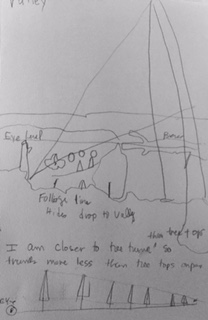
Here is an example of my thinking as I worked today.
FullSizeRender (34)

I learned something important today. The relative position of each part of a large objects (the tops and bottoms of trees for instance) on a page does not change exactly in the same way. Since I am closer to the tree trunks than I am to the treetops, the trunks rise less rapidly than the tops drop. When I draw I need to be mindful of how the scene works as a whole.

I noticed something about my style of drawing today. I usually draw by focusing intently on the small part of an object I am drawing and continue drawing small parts until the page is full rather than planning a drawing ahead of time and then inserting each object into its rightful place. This habit leads to spatial distortions in my sketches. At times this can be exactly what I want, but it should be under my control and not an accidental outcome. So, on with learning about perspective!
Posted in Uncategorized | Tagged | Leave a comment

Trees Everywhere

I have been camping out of internet range and was unable to post. This is the blog I wrote for July 7, 2015

My learning plan for today is to sketch different types of tree- scapes, trees on level land, trees on hillsides, and trees in a valley. I want to understand how the relative position is shown on paper. I will not finish the sketches, just show how the placement on paper indicates proximity to me in the different settings.

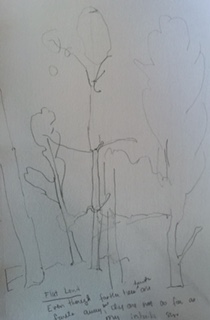
Here is an example of the kind of work I did today:

FullSizeRender (32)

I summarized my learning on each of these sketchbook page. On the page above I wrote, ‘Flatland: Even though far tree trunks are farther away (rise up on the page) they are not as far away as my intuition says. It is tough to say exactly what I am learning, but I now know that  when showing distance, I tend to exaggerate the rise up the page of objects as they recede from me. This gives my sketches a childish look.

Posted in Uncategorized | Tagged | Leave a comment

A Sense of Distance

Learning perspective is challenging. I have habits that are hard to break even when following step by step some of the wonderful demonstrations on-line. Perspective is counter intuitive and I fall into my habitual patterns.

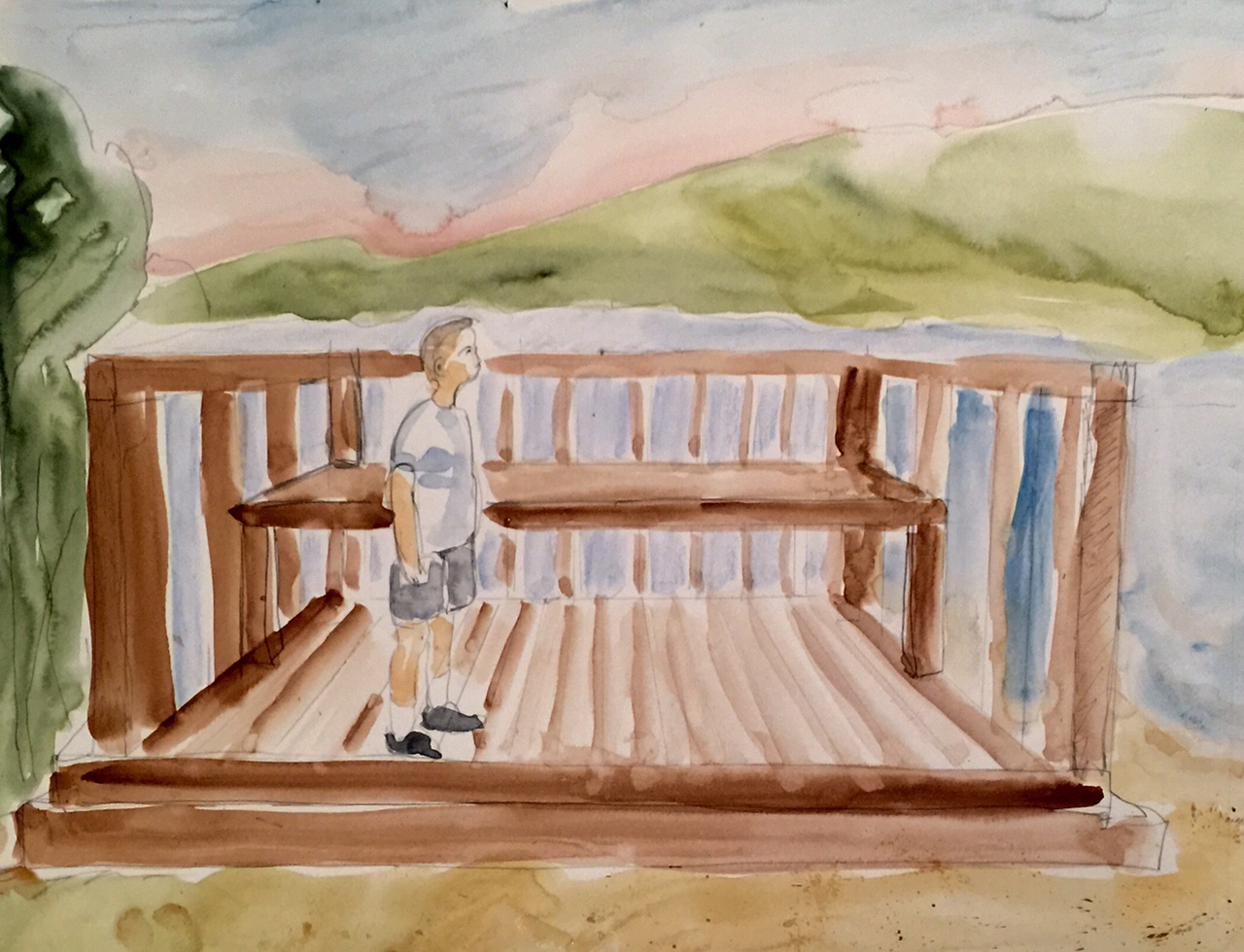
There is a viewing platform at Ridgway Reservoir that I noticed would be perfect for a one point perspective drawing. The platform has lots of vertical and horizontal lines, is set above the water and offers a distant view of green hills across the lake. Through drawing this scene I gained a better sense of how angles work together. Figuring out how to represent the bench was especially helpful.  Tomorrow before we go to our next campground I hope to quickly sketch this platform again.

Senset at Ridgway

Posted in Uncategorized | Tagged , | 2 Comments

Learning Perspective

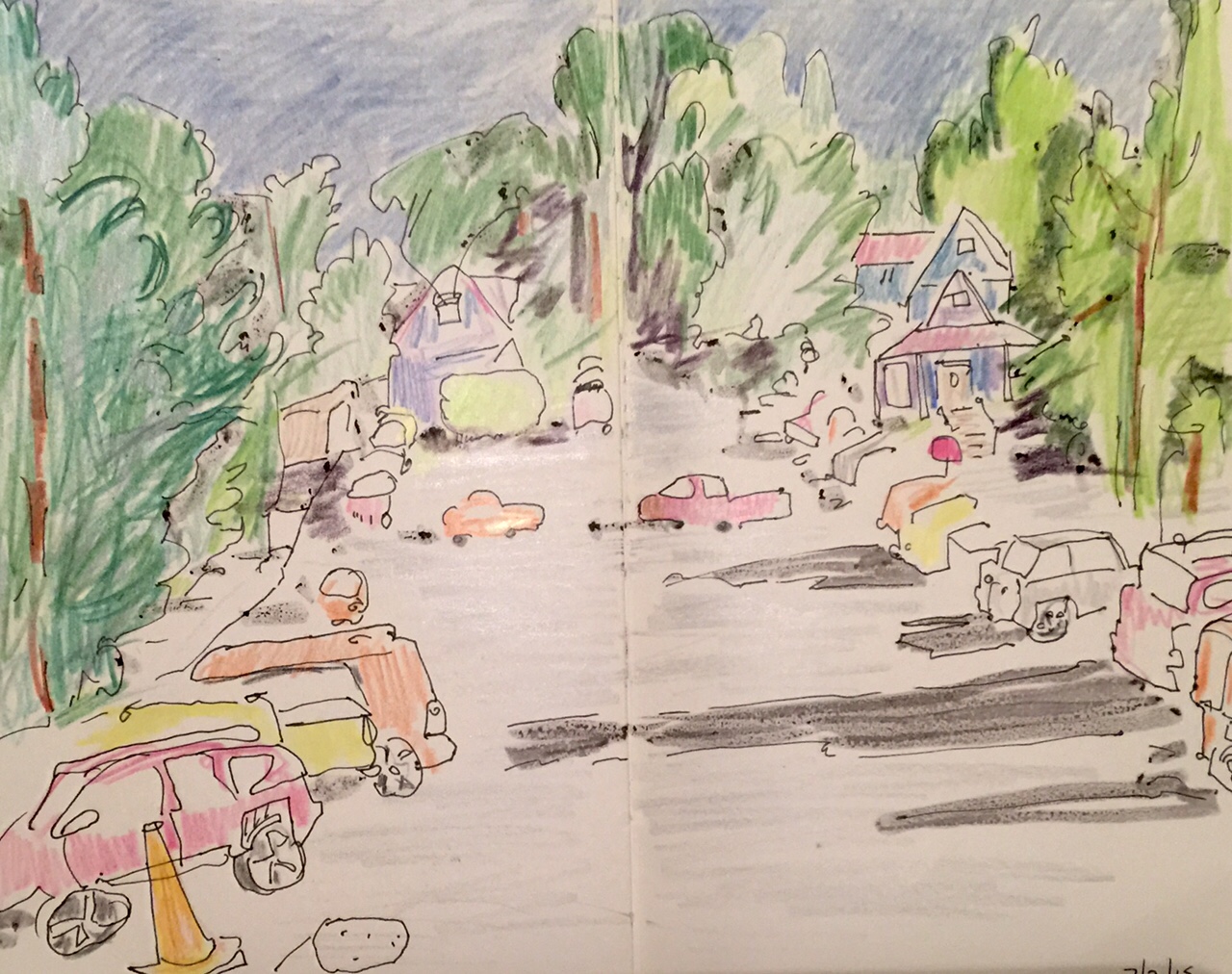
Below is a quick sketch I did of a mountain village street last week. The actual scene is three blocks long and rises steeply uphill. This sketch does not convey the hill or the distance which is why I feel the urgency to work on perspective this week.  I like to place people in the environment in which I see them, and so stronger skills with perspective will help me communicate through image.

Telluride Street

I am camping this week in two different Colorado locals. This afternoon when looking at the gorgeous land around Ridgway Reservoir, I considered how this setting is not at all a traditional subject for a study of perspective. Perspective is often learned by rendering geometric shapes and cityscapes and much less often by drawing in nature.  Even so, the scenes at hand here are full of one and two point perspective opportunities and I believe I can learn much that will help me achieve my goal of communicating through image.

I do have access here to the internet and have begun to practice the basics of one- and two-point perspective. Tomorrow I will apply this knowledge to a forest setting and deliberately practice using perspective.

Posted in Deliberate Practice, Uncategorized | Tagged , | Leave a comment

Fourth of July Greetings

My plan for today was to catch quick actions that would tell a story that anyone could understand. I planned to do it by using gesture drawings of individuals or pairs of people, without background detail. This quick sketch is about three friends exchanging hellos on the Fourth of July, and a fourth person watching it all from the sideline. I went ahead and put in the background, since it helps to tell a story of an unexpected encounter. (In fact, I have trouble not drawing in the background, not adding in color, not closing parts of the drawings and so on. Perhaps I should work on this in the future.)

While I think it is clear that three people are greeting each other while a fourth watches, the drawing is not engaging in and of itself, perhaps because I did not use enough variation from lights to darks.

Fourth of July Greetings 2

———–

Today is the end of my first week as a blogger. Making sense of the technical skills needed for blogging has taxed my thinking but not nearly as much as thinking about the impact of my sketches. I selected this first week’s focus on creating images that communicate because this is the whole point for me of keeping a sketchbook journal.

Thinking about the big ideas of sketching reminds me of the work teachers do with the bits and pieces of helping students meet standards. Standards are huge and take a long time to learn. We educators typically teach a series of lessons across a significant amount of time. The lesson sequence is designed to teach the elements of the standard. We also set up practice opportunities for students to work on the standard. We do not say a student is proficient in the standard until the student can fluently and independently put all its pieces together.

I am about to work on the traditional elements of art over the next few months so that I can fluently and independently use these to communicate my thinking through sketching. I will come back often to this first week’s work since this is the big standard I am working on through the deliberate practice of its elements.

Next week I will be camping and working on perspective. I hope to be able to post daily but if not, I will mass post them on my return.

Happy Fourth of July!

Posted in Body Language, Deliberate Practice, Uncategorized | Tagged , , , | Leave a comment

Getting Clearer

Getting Clearer

With the actual experience of completing four blog posts, I am now clearer on how I can use this process to improve my own work as a sketchbook artist. I see that there are four core questions that are driving my thinking.

  • What is my specific learning goal for the day and what work will I do to learn it?
  • What did I actually do and what is the visual evidence for this?
  • What did I learn, how did I learn it and what else do I need to learn to accomplish my specific goal?
  • What else am I thinking that is relevant to my goal of communicating ideas by using images?

I will use these prompts as a structure for my blog.

Today I plan make numerous sketches of people emoting. I will draw quickly and try to capture through body language something that they appear to be feeling.

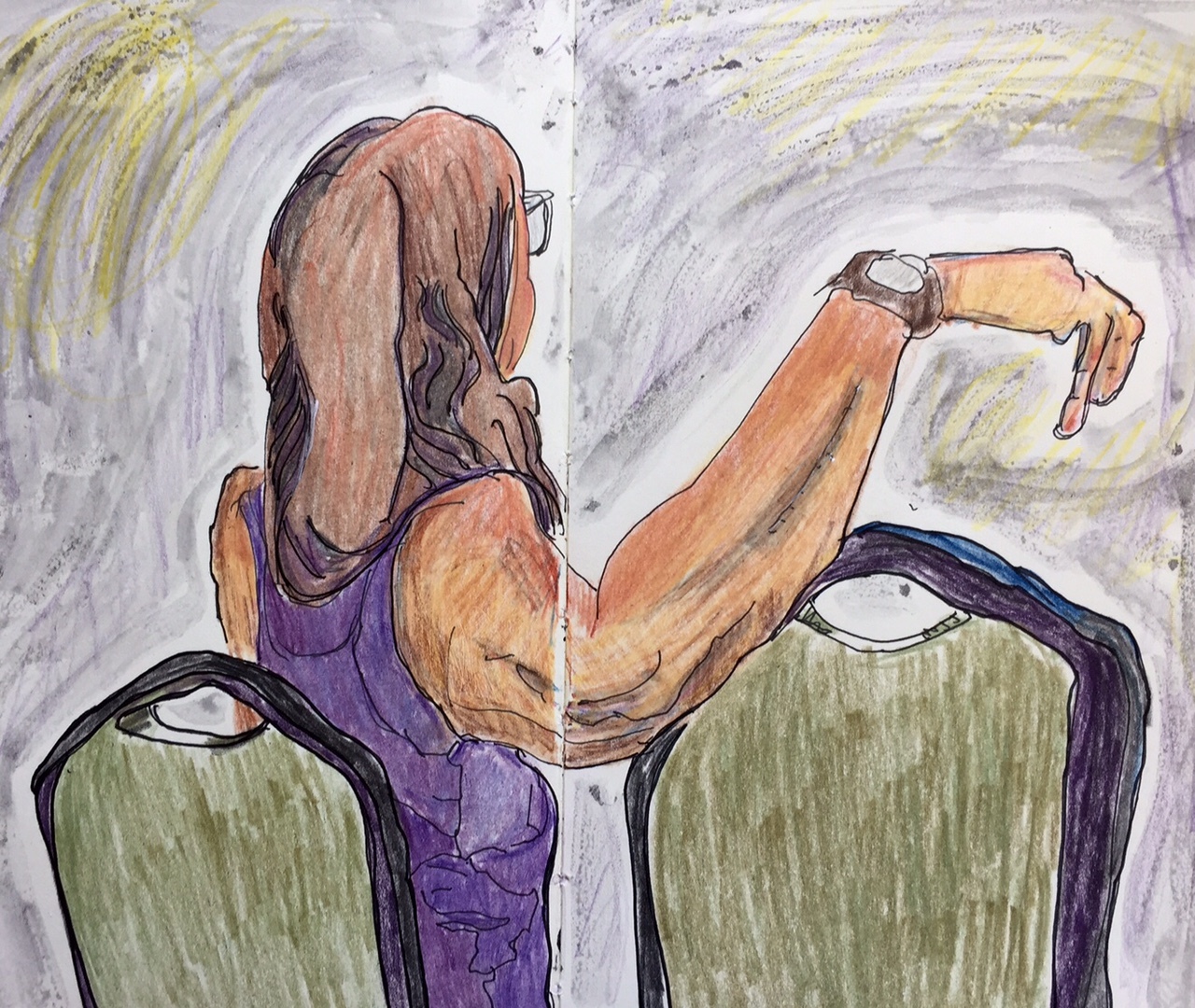
Here is a woman listening to a lecture. I communicate her alert attention to the speaker by having her sit up straight and look directly forward. From her wonderful, relaxed (and way too large) arm, I  think I communicate her calm comfort with the content of the lecture.

Listening to a lecture

Today I watched the model before drawing and think this helped me decide on a few key characteristics to focus on. I wonder if it would have been better to include the speaker the woman was listening to, so we could see who was the object of her attention.

Posted in Deliberate Practice, Uncategorized | Leave a comment

Still Working on Body Language

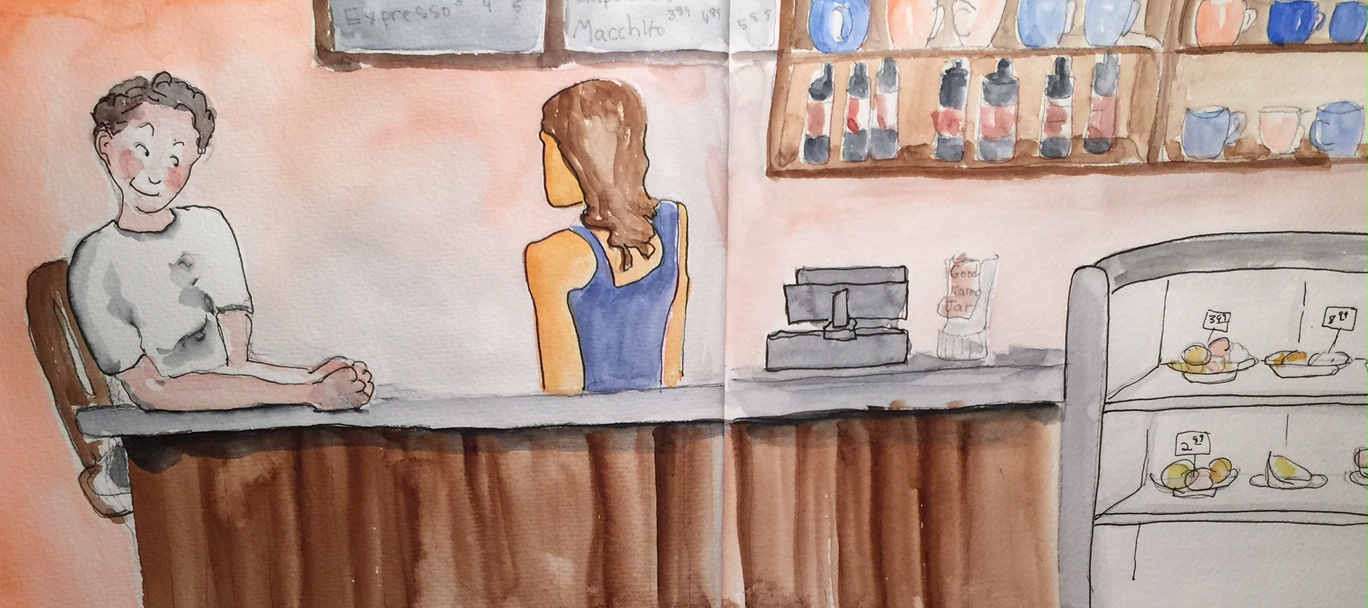
This is the fourth day I have worked with the same basic sketch. At this point I believe I need to set it aside and work on other subject matter, as I am still confused about how to convey the emotions of the customer and barista, which is the point of all this study. I feel the two figures are better drawn and better tinted with watercolor. However, the composition seems to have lost some of the spontaneity of the original sketch. The good news is my other work is conveying more emotion and tomorrow I will blog about this.

Day 4

Posted in Body Language, Uncategorized | Tagged | Leave a comment